Pay Off Student Loans or Invest in Canada? The Real Math
The usual rule — compare your rate to your expected return — was written for a kind of debt most people asking don’t actually have. Here’s the after-tax math that decides it, and the trap that quietly costs the most.
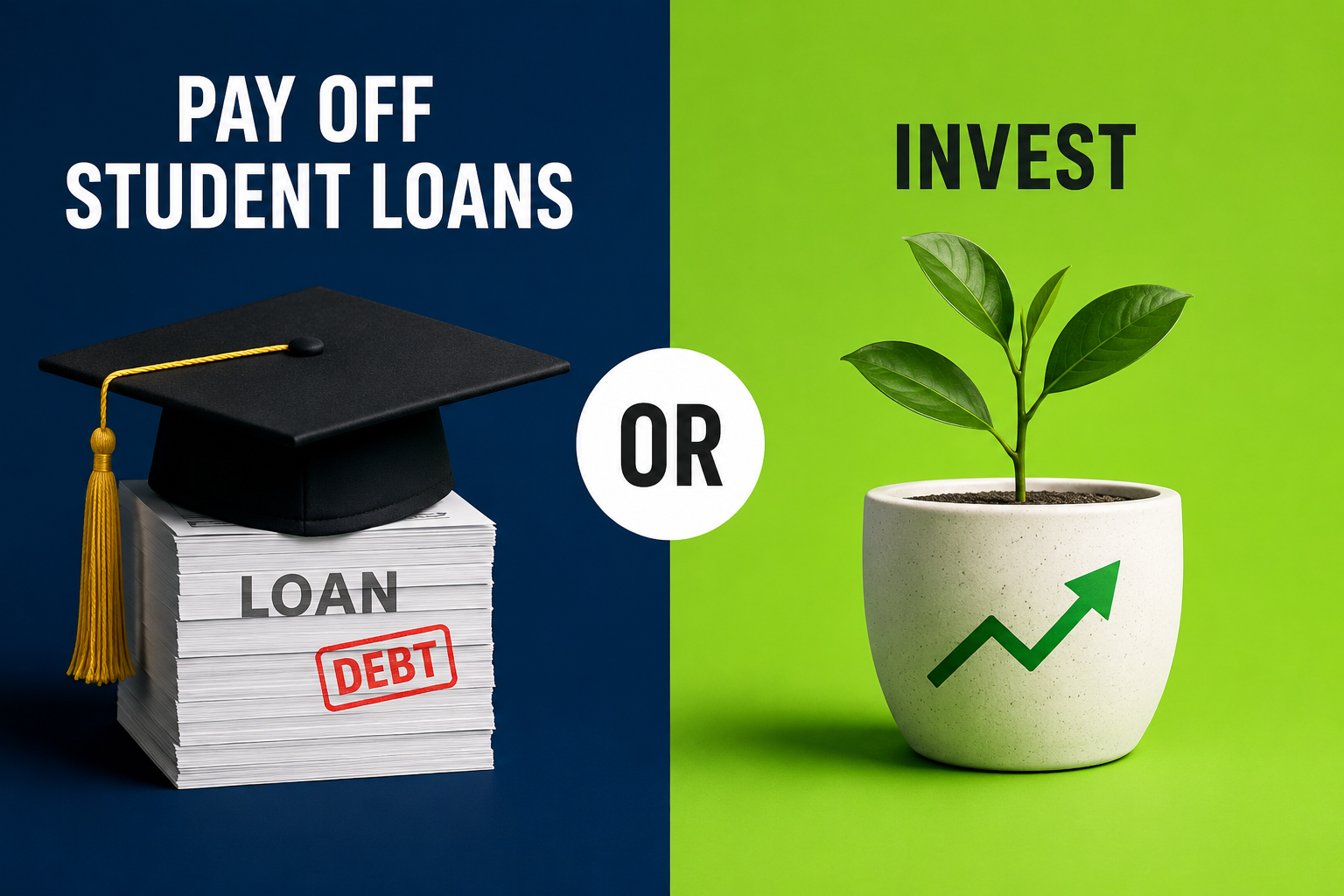
If you’re trying to decide whether to pay off student loans or invest, the standard Canadian answer is short: compare your interest rate to your expected return, invest if you think you can beat the interest rate, and factor in your peace of mind. That advice isn’t wrong. It’s just written for a kind of debt most of the people asking don’t actually have, and it skips the one trap that quietly costs people the most.
Years ago, I had a view that interest rates were probably going lower over the next few years and took on a variable-rate mortgage. I was winning for the first two years but then found out I was wrong and rates started climbing. The painful part wasn’t only that my borrowing got more expensive — it was that my fixed-income investments were falling at the same time. Rising rates hit both sides of the ledger at once. That experience is the whole reason I think this question deserves more than a rule of thumb.
First, what kind of debt do you actually have?
Before any math, name the type of debt because two very different things get called “student debt.”
A federal Canada Student Loan has been permanently interest-free since April 1, 2023; no new interest accrues. If that’s the debt in question, the comparison is lopsided: any positive return beats a zero-percent cost, so the math rarely argues for rushing to repay (the required payments still get made, and they still affect borrowing capacity for a mortgage later).
Most high earners asking this question aren’t in that situation. A doctor, dentist, or lawyer typically carries a professional student line of credit (LOC), which is a revolving bank loan. This is often $150,000 to $350,000, priced at or near the prime rate. Recent rates run from roughly prime minus 0.25% for medical and dental borrowers up to about prime plus 1% for other programs. That’s a completely different animal: the rate floats, and the interest generally isn’t tax-deductible. The internet’s “student loan” advice wasn’t written for it.
The returns: paying down removes a cost, it doesn’t earn a return
Here’s the cleanest way to see the trade-off. Paying down the balance has one certain effect: the interest stops. If a LOC costs 4.5%, every dollar put against it is a dollar that’s no longer costing 4.5% a year, guaranteed. That’s not a 4.5% “return” in the investing sense; it’s a 4.5% cost removed. The effect on net worth looks similar, but the certainty is the whole point.
Keep the balance and invest instead, and it becomes a different bet: that the portfolio out-earns the loan. The gap between the two - portfolio return minus borrowing cost, is the only part anyone actually pockets. Planners call that gap the spread.
And the spread that counts is the one after tax
Two simple facts turn the headline numbers into the wrong numbers:
- Interest on a professional LOC generally isn’t deductible. (The student-loan interest tax credit applies only to government loans — which are interest-free anyway.) So, the cost of the debt is the full rate, with no tax break softening it.
- Where the money is invested changes what’s kept. Gains inside a TFSA (tax-free savings account) are tax-free; an RRSP (registered retirement savings plan) contribution produces a refund at the marginal rate, and that refund can itself go against the balance.
So the honest comparison isn’t “market return vs. loan rate.” It’s after-tax return vs. after-tax cost. For a high earner, tax treatment often moves the answer more than the headline rates do.
The trap almost nobody mentions: don’t let the market set the rule
This is where the popular rule of thumb quietly backfires. “Invest if your return beats your rate” holds up, but only when “return” means a long-run expected return, not whatever the market did this month.
Over a horizon of ten years or more, a diversified portfolio’s expected return tends to sit above a prime-ish borrowing cost — but by less than the headline implies. FP Canada’s 2026 Projection Assumption Guidelines, the same benchmark behind our retirement series, put long-run equities around 6.3–6.4% and the borrowing rate at 4.4%. A realistic blended portfolio (not 100% equities) sits below the equity figure, and investment fees come off the top, so the true after-fee edge over a ~4.4% loan is often closer to a point than the two-plus the raw numbers imply. These are nominal figures, which is exactly what this comparison needs: a loan rate is nominal too, so inflation sits on both sides of the spread and cancels. (That’s why this post uses a ~6% nominal return where the retirement series used a 3% real one — same source, but a debt decision is measured in nominal dollars and a decades-long projection in real ones.) The assumptions are also built to look past today’s rate environment.
Apply the rule to the present moment instead, and it inverts. In a market correction the portfolio is down, so the rule whispers “stop investing”, exactly when forward returns tend to be highest. Near a peak it says “pile in”, when forward returns tend to be lowest. Followed literally, a moment-by-moment spread check nudges people to buy high and skip the dips.
There is one override that is genuinely rational, because it reacts to a known number rather than a forecast: if a variable LOC rate climbs above the long-run expected return, the spread really has flipped for that window, and paying down does the most good. That’s responding to a fact you can observe, the rate, and not trying to time a market you can’t time deliberately.
That’s the lose-lose from my mortgage story: rates and asset prices move together, so reacting to the moment can hurt on both sides at once. FP Canada even publishes a correlation matrix for precisely that reason. The durable takeaway is to anchor to long-run expectations and let a known number, the rate, do the moving…not the market’s mood.
The part the math can’t settle
The spread is arithmetic. How you sleep isn’t. Carrying a six-figure balance to chase a slim spread is a real weight for some people, and choosing to clear it anyway isn’t irrational, it’s buying certainty, and certainty has a price worth naming.
There’s also a behavioural asymmetry the spreadsheets miss: a paid-down balance can’t be sold in a panic, but an invested dollar can. For anyone who suspects they’d bail in a downturn, the “behavioural return” on simply repaying the debt can beat a spread that would have been earned on paper and then surrendered at the bottom.
For what it’s worth, my own temperament leans toward keeping the spread working, but that’s how I like to do things and I’m not you.
So, pay down or invest?
The real answer is that it’s the wrong first question. The better starting point is the kind of debt involved. The comparison that matters is after-tax. The anchor that holds up is long-run expectations, not this month’s headlines. And the final step: what’s comfortable to live with…is personal. The arithmetic narrows the choices; the last call is yours.
Seeing all of it in one place: the balance, the rate, the accounts and the spread; is what makes that decision concrete instead of abstract. That full-picture view is what YouGotThis is built to give you.
Frequently asked questions
Should I pay off student loans or invest in Canada?
It depends on the kind of debt. A federal Canada Student Loan is interest-free, so any positive investment return outpaces it. A floating-rate professional line of credit creates a real spread to weigh — and the comparison that matters is after-tax return versus after-tax cost, anchored to long-run expectations rather than the current market.
Is interest on a student line of credit tax-deductible in Canada?
Generally, no. The federal student-loan interest tax credit applies only to government student loans (Canada Student Loans and their provincial equivalents). Interest on a bank-issued professional student line of credit typically does not qualify, so its full rate is the real cost of carrying the balance.
Are Canada Student Loans still interest-free?
Yes. The federal government permanently eliminated interest on Canada Student Loans as of April 1, 2023, so no new federal interest accrues. Any interest from before that date is still owed, and provincial or bank-issued student loans may still charge interest under their own terms.
See your complete financial picture in one place.
YouGotThis helps professionals with complex financial lives understand where they stand — investments, debt, retirement, education, estate — all in one view.
Get started free →Educational illustration only. Not financial, investment, tax, or legal advice. Interest rates, return assumptions, and tax treatment are illustrative, vary by lender and by individual circumstances, and change over time. The figures are meant to build intuition, not to size any individual’s decision — confirm current loan terms and tax rules for your own situation.